Since January 20, 2025, global health is bursting with good-faith arguments on why US led foreign aid needs to be saved. This is a coping mechanism for a field fundamentally altered—you might salvage some parts, but global health’s transformation is irreversible. The epitaph has been signed. You can call it a ‘paradigm shift’ or a ‘qualitative change’, but for clarity, I call it the death of global health.
People devoted to the field are grieving, but there is a mistaken desperation to cling to hope, a hastiness towards tepid silver-linings. This is understandable because the last epoch of global health was driven by ‘impatient optimism’ – the callsign of the Gates Foundation, an entity that governed global health not just through its vast funding but its power to define who and what mattered in the field. The co-founders often used ‘impatient optimist’ to describe themselves because they were “impatient for the world to get better, and optimistic that it will.” Impatient optimism was also the title of a 2012 book on Bill Gates. In fact, if you google ‘impactoptimists.com’, it still directs you to the Gates Foundation website. This paradigm of reckless optimism—that things weren’t as bad as they seemed on the news; that diseases, civil wars and poverty would disappear by 2035—became global health scripture.
But self-deception and false optimism have no place among serious thinkers and principled actors, especially in a crisis—the collapse of US-led global health is not just the downfall of an industry or field, it exposes a civilizational threat because we are no longer even pretending that saving lives and alleviating suffering are public goods. No matter where you are, you are witnessing humanity fail itself. You can break the cycle or repeat it. But change requires us to be clear-eyed about how we got here.
In this piece, I propose a new foundation for organizing efforts to ease suffering, protect people from harm, and intervene in preventable threats to life. That foundation is patient pessimism. First, I present two structural flaws that led to the collapse of global health.
Global health is the master’s tool
For the past month, even the most well-meaning arguments about saving USAID have endorsed the ‘soft power’ justification – framing health and development funding as a tool for U.S. supremacy and the rejection of alternatives. This is willful ignorance of the congenital disorder that plagues global health: colonization. The field began as a tool for empire, with biomedical and sanitary interventions in European industrial centers and in Asian and African colonies to manage the value that labor and native populations for capital expansion. From the start it has served colonial expansion, racial subjugation, genetic ‘improvement’, and both hot and cold warfare.
Efforts to address this legacy were cosmetic rebranding initiatives— from tropical medicine to public health to international health. ‘Global’ health was a forced renewal, distancing itself from its colonial and Cold War roots while remaining tethered to the same logics of power. The refusal to confront these origins—or the belief that incremental reforms, smart grant proposals, polished conferences can “fix” them—only ensures that research and policy efforts continue to serve globalized exploitation of people and nature. This ensures that human rights, universal healthcare, international treaties, and humanitarian aid are used as mechanisms for measuring human life based on how valuable we are to the empire.
We live in a world where economic considerations consume all other dimensions of life. Decisions on how, when, where to protect human life are dictated by those who hold economic power—both within countries and between countries. Appealing to governments as central authority on public health is a relic of the past. Let’s stop pretending that global health didn’t undermine government capacity—bypassing public health systems, creating parallel structures, subjecting it to market logic, and reducing care to charity or experimental trials rather than a universal right.
We allowed cost-benefit analysis, financial returns, and economic participation become the justification for saving lives and empowering people. We watched unprecedented accumulation of wealth, consolidating power in fewer hands. And so, we find ourselves in a world where freedom and rights are no longer the terms of the debate.
Good health does not ‘trickle’ down
US-led global health efforts epitomize the fallacy of ‘doing well while doing good’—that the ruthless economic and political exploitation of the world can contribute positively to society by giving back. Bill Gates first read about health inequities in 1993 and decided to ‘give back’ to the world by changing the course of global health. Bill was going to ‘help those who cannot help themselves’ and former wife, Melinda French was going to speak on behalf of those she deemed voiceless. And yet, a more tangible impact on global health would have come from acknowledging that millions are kept helpless and voiceless by the very system that made their wealth and charity possible.
It is incorrect to say that rich people invest in global health to make a profit. The reality is far worse. Private foundations reinforced the tendency to measure human wellbeing in terms of economic values, reducing health and dignity to productivity metrics and market efficiency. But championing antiracism, gender justice, and universal healthcare are deeply inconvenient to those who hold power. Showcasing instrumentality to politicians and corporations is such a necessity that global health folk treat it as gospel. The economic rationale offered a sliver of commitment—secured attention when it promised higher GDPs, stronger families, and a more productive workforce—only to be abandoned the moment it became too disruptive, too radical, too real.
The fault of Bill Gates and Melinda French is not that they are ‘impatient optimists’ about the state of the world but that they refuse to seriously consider their own place in it. The Foundation neither questioned the impact of its power in global health, nor allowed meaningful scrutiny of the same. Instead, it used its vast resources to position itself as an evidence-based force for good, maintaining a façade of openness to criticism while steadily expanding its influence across all aspects of the field.
Economic framing isn’t inherently useless, but when everything is measured in financial returns and future productivity, the logic becomes clear: people exist to serve capital, not the other way around. The Gates Foundation, with its emphasis on cost-effective technical interventions, has a presence in the US and 135 other countries. It is saving lives, but it is also uplifting people to serve a structurally unjust system—one shaped by racial, ethnic, and caste-based discrimination; labor exploitation; land dispossession; and unfair tax, trade and debt regimes. This is not about greed or malice—it is a deep failure of imagination. By refusing to rectify this, while also insisting that all lives have equal value, the Foundation allows for lives to be reduced to currency—subject to devaluation, inflation, and obsolescence depending on how our illness, disability, and death impacts the economy.
We need patient pessimism
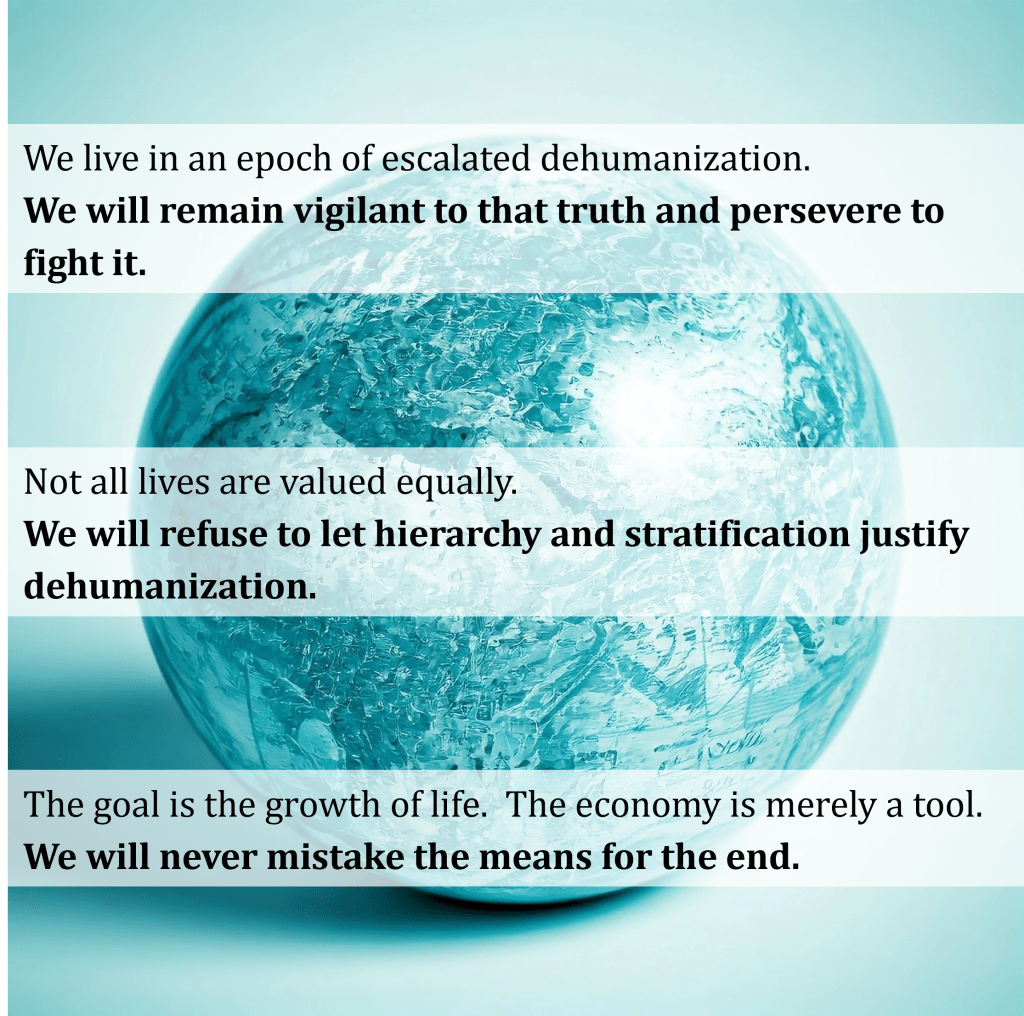
“A liberal is a man too broadminded to take his own side in a quarrel.” – Robert Frost.
Change does not come from successfully persuading powerful people in rich countries to tolerate, endorse, and fund your agenda. You are let into the temple only when you are considered safe, someone who will not burn it down. This breeds contradictory compromises, shifting goalposts, unfinished agendas—a cycle of managing dissent and alternatives that might disrupt the status quo. Perhaps global health’s contradictory compromises grew so vast that the center simply could not hold.
This is why you should not give into hasty optimism. Instead:
Be patient. Regimes of concentrated power rest on fragile piles of contradictions. These structures inevitably break down as they push more and more people into conditions of stress and precarity. When unrest grows, those in power respond with outright violence (hard power) and hollow compromises (soft power). These tactics prolong suffering and strengthen control. This deepens discontent. Being patient means remaining vigilant: learn to recognize cracks where the system sows the seeds of its own undoing rather than waste your energy reinforcing soft power.
Be pessimistic. When unrest grows, people in power cling to their status through force, manipulation, or co-optation. Global health was the softer option, and it failed miserably at preventing dehumanization through inequality, violence, genocide, and war. We should be very distrustful of what is unfolding. People are not okay and there is no invisible hand bending the arc of the moral universe towards justice. Perhaps, “new global health” should be organized around a more realistic goal: to save our species from our innate capacity to destroy each other.
Patient pessimism is not an intellectual pose or passive excuse for inaction. To remain humanized is an inalienable and intrinsic good. We still get to be okay when we are not useful; when we desire differently, when we ask uncomfortable questions. We get to live without the fear of being punished, abandoned, or actively killed. Things are getting worse, which is precisely why we must act. But we must be clear-eyed about the structural flaws we are leaving behind and the integrity of what are building next.
For instance, the US stepping away from global health may have an unexpected consequence: we may no longer need to ‘decolonize’ global health— a struggle that, in practice, was already at risk of being diluted or depoliticized without real accountability. This is a fight that global health was unlikely to take on without extinguishing itself in the process. But it never got the chance. It is a ‘soft power’ tool that was put back in the box, because it was deemed unnecessary for now. If the language of DEI is no longer a viable cover, neither is the half-hearted appropriation of gender equality, transgender rights, antiracism, equity and so on. Whatever form global health takes now must be driven by ambitious interventions and rigorous evidence towards more expansive, interconnected vision of humanity. Let that be the foundation. Solutions and pathways will follow.
 Vyoma
Vyoma 